
Why cheap concrete quotes are the most expensive mistake you can make
When comparing concrete quotes, most people focus on one number: the initial price.
But in real-world construction, the true cost of concrete work is shaped by far more than what appears at the bottom of a quote.
Poor site preparation and workmanship, unclear scope, and coordination failures routinely turn “cheap” concrete jobs into expensive problems. These issues don’t always show up immediately. They surface months or years later as cracking, movement, drainage failures, or compliance issues.
This article explains what drives the real cost of concrete work, how to interpret quotes properly, and how to avoid false savings that lead to long-term expense.
What “Cost” Really Means in Concrete Construction
The real cost of concrete work includes:
Materials
Labour
Site preparation
Reinforcement systems
Curing and finishing
Project coordination
Risk management
Long-term performance
A cheaper quote may reduce or omit several of these areas. The result is often higher total spend across the project lifecycle.
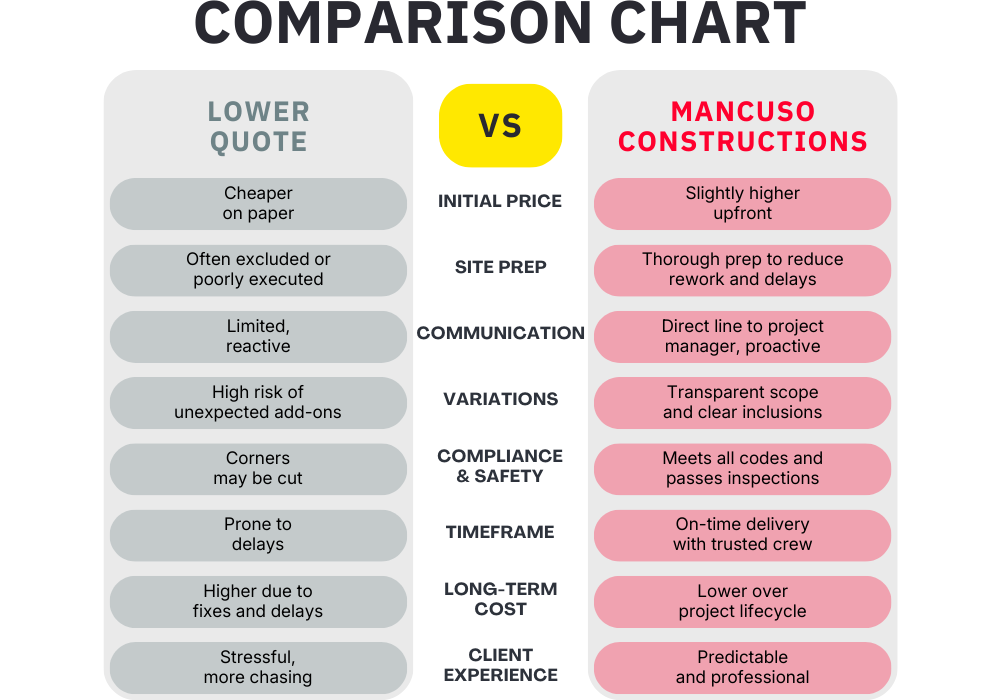
This difference is why two concrete quotes that look similar in scope can perform very differently once construction begins.
1. Site Preparation: The Foundation of Everything
Quality concrete begins before any concrete is poured. Proper site preparation typically includes:
Excavation to correct levels
Removal of unsuitable material
Compaction of subgrade
Installation of crushed rock base
Moisture barrier (plastic membrane)
Level tolerances
When site prep is skipped or rushed:
Slabs settle
Cracks form
Drainage issues appear
Structural movement increases
These failures often require expensive rectification such as slab replacement, resin injection, or underpinning.
2. Reinforcement: What You Don’t See Still Matters
Reinforcement is one of the most common areas where corners are cut. Correct reinforcement design considers:
Slab thickness
Load requirements
Soil classification
Engineering specifications
Rebar size and spacing
Mesh type and placement
Using inadequate reinforcement or placing it incorrectly increases the likelihood of cracking and structural weakness. Once concrete is poured, reinforcement cannot be upgraded without demolition.
3. Concrete Strength, Mix Design, and Placement
Concrete is not a single product. Important variables include:
MPa rating (e.g., 25MPa, 32MPa, 40MPa)
Aggregate size
Cement content
Water-to-cement ratio
Admixtures
Adding extra water to make concrete “easier to place” reduces strength and durability. Correct placement requires:
Controlled pour sequencing
Vibration
Edge form integrity
Finishing at the correct time
These details directly impact surface hardness, cracking, and longevity.
4. Curing: The Most Overlooked Cost Factor
Concrete gains strength through curing, not just drying. Proper curing involves:
Moisture retention
Temperature control
Protection from wind and sun
Curing compounds or wet curing
Poor curing can significantly reduce final strength. This means a slab designed for long-term performance may never reach its intended strength.
5. Compliance, Engineering, and Inspections
Concrete work must comply with:
Australian Standards
Engineering drawings
Building surveyor inspections
Non-compliant concrete can result in:
Failed inspections
Stop-work orders
Demolition and re-pouring
Insurance issues
Cheap quotes often exclude compliance coordination. Experienced concrete contractors manage this process as part of the service.
6. Project Coordination and Flow-On Costs
Concrete sits at the centre of most builds. When concrete is delayed or defective:
Framing is delayed
Waterproofing is delayed
Brickwork is delayed
Fit-out is delayed
These delays cascade across trades and inflate project costs far beyond the original concrete price difference.
Common Pitfalls With Cheap Concrete Quotes
Hidden exclusions
Inexperienced crews
Extra costs after work starts
Failed inspections
No-shows or last-minute changes
Poor slab quality
Cheap quotes rarely remain cheap.
What You Get With Mancuso Constructions
A team that shows up and gets it done right
Clear, detailed quotes with transparent inclusions
Strong relationships with inspectors and site managers
Proven systems for basements, slabs, and structural concrete
Work that protects your reputation with your client
If you’re planning a slab, basement, or structural concrete package in Melbourne, speak with Mancuso Constructions. We provide clear scopes, realistic pricing, and concrete work that passes inspections and performs long-term.